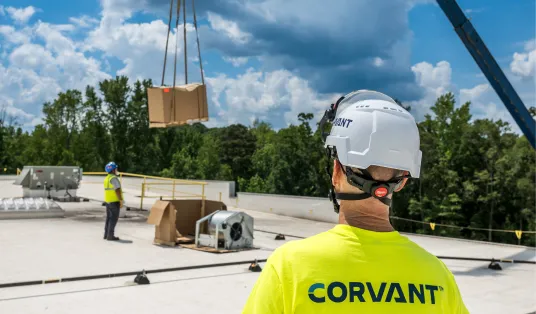
Success depends less on any single technology than on how the work is planned, built, and maintained. Facilities that treat modernization as a full-lifecycle program, with one accountable partner from design through ongoing service, carry far less risk than those that piece the work together vendor by vendor.
What Is Mission-Critical Infrastructure?
Mission-critical infrastructure is the set of building systems a facility cannot operate without — where a failure stops production, takes services offline, compromises security, or puts people at risk. In most facilities, the mechanical and plumbing systems sit at the center of that infrastructure.
What counts as mission-critical depends on the facility:
- Data centers: cooling and chilled-water piping that keep IT equipment within operating limits around the clock.
- Hospitals: HVAC, steam, and plumbing systems that support patient care and life safety.
- Advanced Manufacturing: process HVAC and exhaust systems that are part of the production process itself, not just occupant comfort.
- Aerospace and Defense: cleanroom environments where temperature, humidity, and air quality must stay within tight tolerances.
- Logistics and Warehousing: mechanical systems that support automated, robotics-driven operations at large scale.
The common thread is that downtime is not an option. In an ordinary commercial building, a mechanical failure is an inconvenience. In a mission-critical facility, it has direct operational, safety, or business consequences — which changes how the infrastructure must be designed, built, and maintained.
That is the category Corvant serves: full-lifecycle mechanical and plumbing solutions for mission-critical facilities, from design and procurement through installation, asset management, and ongoing service.
What Makes Mission-Critical Infrastructure “Modern”?
Modern mission-critical infrastructure is defined by higher loads, tighter tolerances, larger scale, and greater integration with the operations it supports. Systems designed a decade or two ago were often built for lighter demands than facilities place on them today.
Several shifts are driving the change:
- Higher heat density. In data centers, denser server racks concentrate more heat in less space, driving adoption of approaches such as liquid-to-chip and in-rack cooling alongside traditional air systems.
- Larger facilities. New data centers, manufacturing plants, and fulfillment centers are being built at a scale that demands extensive piping networks and highly coordinated mechanical installation.
- Automation. Robotics-driven fulfillment and continuous-production manufacturing depend on mechanical systems that perform consistently, because a failure can ripple across an entire automated process.
- Tighter environmental control. Cleanrooms and precision manufacturing require systems that hold conditions within narrow ranges at all times.
- Better visibility. Modern controls and monitoring let facility teams track system performance continuously, rather than discovering problems only when an alarm sounds.
Growth is accelerating these shifts. Data center expansion in particular is bringing new capacity, new markets, and new urgency — and the mechanical partners behind that growth need to keep pace without cutting corners.
“Modern” is not about adopting new equipment for its own sake. It is about matching the infrastructure to what the facility actually demands today, and building it so it can be maintained and renewed reliably for years to come.
How Do You Modernize Mission-Critical Infrastructure Without Disrupting Operations?
Modernizing mission-critical infrastructure without disruption requires phasing the work so the facility always has enough capacity to keep running, and following written procedures the facility’s operations team agreed to in advance. Most mission-critical facilities cannot shut down for construction, so the upgrade has to happen around live operations.
Practices that make this possible:
- Map dependencies first. Know which systems support which operations, and where redundancy exists, before planning any work.
- Phase the work. Break the project into stages so no single step removes more capacity than the facility can spare.
- Write the procedure before starting. Document each step — how equipment is isolated, what is monitored, and how it is returned to service — plus rollback steps if conditions change.
- Respect the facility’s protocols. Secure and cleanroom environments have access, security, and contamination-control requirements that apply to every person and every tool on site.
- Coordinate continuously. Agree on work windows, communication paths, and escalation with the facility team, and keep them informed throughout.
Corvant’s work with Airbus U.S. Space & Defense shows what this looks like in practice: a secure cleanroom expansion and renovation completed inside an active aerospace manufacturing facility. This is the work of Corvant’s Retrofit & Replace service line — upgrading existing systems in facilities that must keep operating.
Why Does a Full-Lifecycle Approach Reduce the Risk of Adopting New Infrastructure?
A full-lifecycle approach reduces risk because one partner is accountable for the infrastructure from planning through installation, upgrades, and ongoing service — so nothing is lost in the handoffs between vendors. When design, construction, and maintenance are split across separate firms, each handoff creates opportunities for knowledge to disappear and accountability to blur.
Corvant’s full-lifecycle solutions cover four service lines:
| Service Line | Stage of the Infrastructure Lifecycle |
| Program Management & Consulting | Design and procurement — planning the system and the program around it |
| Build & Integrate | Installation — building new systems and integrating them with live operations |
| Retrofit & Replace | Asset management — upgrading or replacing existing systems |
| Service & Maintain | Ongoing service — planned maintenance programs and 24/7 emergency response |
The benefit is continuity. The team maintaining a system understands how it was designed and installed. The team planning an upgrade has the maintenance history to show which assets are actually limiting performance. And when something fails, the people responding already know the site.
This is what “One Team. One Purpose.” means in practice. It also matters because Corvant’s commitments matter as much as its technical capability at every stage, not just the one in the current contract. Learn more about how Corvant approaches mission-critical construction and mechanical integration.
What Does Modern Mission-Critical Infrastructure Look Like Across Industries?
Modern mission-critical infrastructure looks different in every industry, but the standard is the same: systems built to the scale and tolerances the operation demands, delivered without disrupting the operation itself. Corvant’s project work spans five of the most demanding facility types:
| Industry | Project | Infrastructure Delivered | Service Line |
| Data Centers | Hyperscale technology company | More than 10 miles of fusion-welded piping in a 600,000-sq-ft data center | Build & Integrate |
| Advanced Manufacturing | Canadian Solar | Integrated HVAC and exhaust systems for a 750,000-sq-ft facility | Build & Integrate |
| Aerospace & Defense | Airbus U.S. Space & Defense | Secure cleanroom expansion and renovation inside an active manufacturing facility | Retrofit & Replace |
| Logistics & Warehousing | Amazon | Mechanical systems for a large-scale, multi-story, robotics-driven fulfillment center | Build & Integrate |
| Healthcare | AdventHealth Celebration | Emergency mobilization within hours to restore a critical steam system | Service & Maintain |
Two patterns stand out. First, scale: these facilities range from 600,000 to 750,000 square feet, with infrastructure measured in miles of piping rather than feet. Second, the work does not end at installation. The AdventHealth Celebration response shows the other half of mission-critical infrastructure — when a system fails, restoring it fast is as important as how well it was built.
Modern infrastructure is only as reliable as the team that keeps it running.
How To Get Started Adopting Modern Mission-Critical Infrastructure
The best starting point for adopting modern mission-critical infrastructure is an honest assessment of where your current systems fall short of what your operation now demands. Three questions frame that assessment:
- Where is the gap between demand and capacity? Identify the systems running closest to their limits — whether from higher heat loads, expanded production, or tighter environmental requirements.
- What can be upgraded in place, and what needs replacing? Maintenance records and performance trends show which assets can be improved and which have reached the end of their useful life.
- Who will own the outcome? Decide whether you want separate vendors for planning, construction, and service, or one partner accountable across all of them.
Whatever the answers, plan the work around continuity. The right modernization program protects operations at every step, and leaves behind infrastructure that your team — and your maintenance partner — can keep running reliably for years.
Corvant has delivered mechanical and plumbing work for mission-critical facilities since 1962, with field teams across more than 20 states in the Southeast. Contact us to learn more.